The Campaign Against Privatization and Commercialization of Education (CAPCOE) has issued a damning indictment of Ghana’s basic education infrastructure, describing the continued existence of over 5,400 “schools under trees” as a national disgrace and a betrayal of the country’s future.
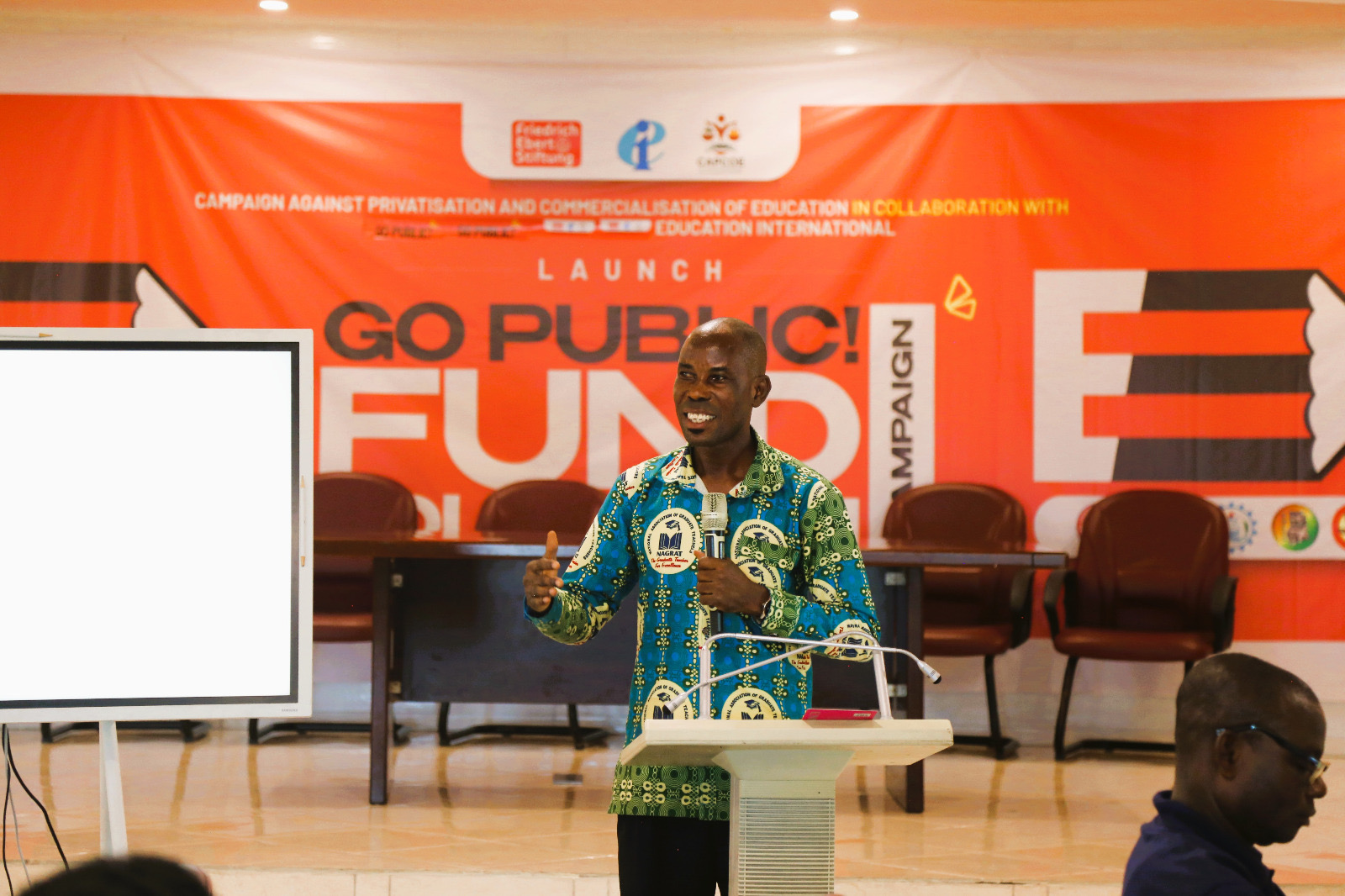
Speaking to journalists in Accra, Richard Kwashie Kovey, Convener of CAPCOE, said the situation is no longer just a policy failure but a humanitarian crisis that demands immediate and sustained national action.
“Beyond the numbers are real children whose dreams are at stake because of all the odds stacked against them. This is a national shame, and it must not be normalized any longer,” Mr. Kovey stressed.
Despite Ghana’s image as a beacon of stability in West Africa, vast numbers of children—particularly in rural and underserved communities—are still learning in open-air environments without shelter, furniture, textbooks, or trained teachers. According to Kovey, this stark inequality makes a mockery of the country’s constitutional promise of free and compulsory basic education.
Citing recent data, CAPCOE noted that over 1.2 million children aged 4 to 17 have never been to school, while an estimated 30 children drop out every single day, often due to the lack of accessible and conducive learning spaces.
“We are in 2025, and yet we are still talking about children learning under trees. How do we expect them to compete in a digital world when we haven’t even provided them with a roof?” Kovey asked.
He further criticized the government’s spending priorities, pointing out that in 2023, only 20% of the Ministry of Education’s budget went to basic education, with a significant portion channeled toward tertiary institutions and administrative overheads.
“We’ve allowed our spending to favor prestige over priority. Tertiary education is important, but without a strong foundation in basic education, we are building castles in the sand,” he lamented.
CAPCOE, alongside other civil society organizations such as Africa Education Watch (Eduwatch), Education International (EI), and the Friedrich-Ebert-Stiftung (FES), is calling for urgent reallocation of resources. They estimate that GHS 3.5 billion is needed to eliminate the ‘schools under trees’ phenomenon entirely—a goal they argue was achievable between 2021 and 2024 if the Ghana Education Trust Fund (GETFund) had been better utilized.
“It’s not a question of whether we can fix this—we can. The real question is whether we’re willing to prioritize the children in deprived communities who have been forgotten for far too long,” Kovey declared.
Parliament recently approved GHS 800 million for basic education in 2024, the highest allocation in seven years. While this has sparked hope among education advocates, Kovey cautioned that the funds must be targeted carefully.
“This money must not be swallowed by bureaucracy. It must go directly to the most deprived schools—the children under trees, in sheds, in broken classrooms. That’s where Ghana’s future is being decided,” he insisted.
The coalition of civil society voices is also urging government to redirect a portion of Ghana’s oil revenue into foundational education, arguing that no investment offers greater national return than educating the youngest citizens.
“We cannot industrialize or digitize if we ignore the very foundation. The child sitting under a tree today could be the next doctor, teacher, or engineer—but only if we give them a fighting chance,” Kovey concluded.
As pressure mounts on the Ministry of Education and central government to take decisive action, CAPCOE and its partners say they will continue to raise awareness until every Ghanaian child has a dignified place to learn—under a roof, not under a tree.