
Noise pollution in FM Studios threatens health- New KNUST research reveals hidden dangers in Media stations
By: Evans Osei-Bonsu
A leading Ghanaian Architectural Scientist has raised concern over excessive noise levels in radio broadcasting environments, particularly FM stations, warning that poor indoor environmental quality (IEQ) poses serious health and productivity risks.
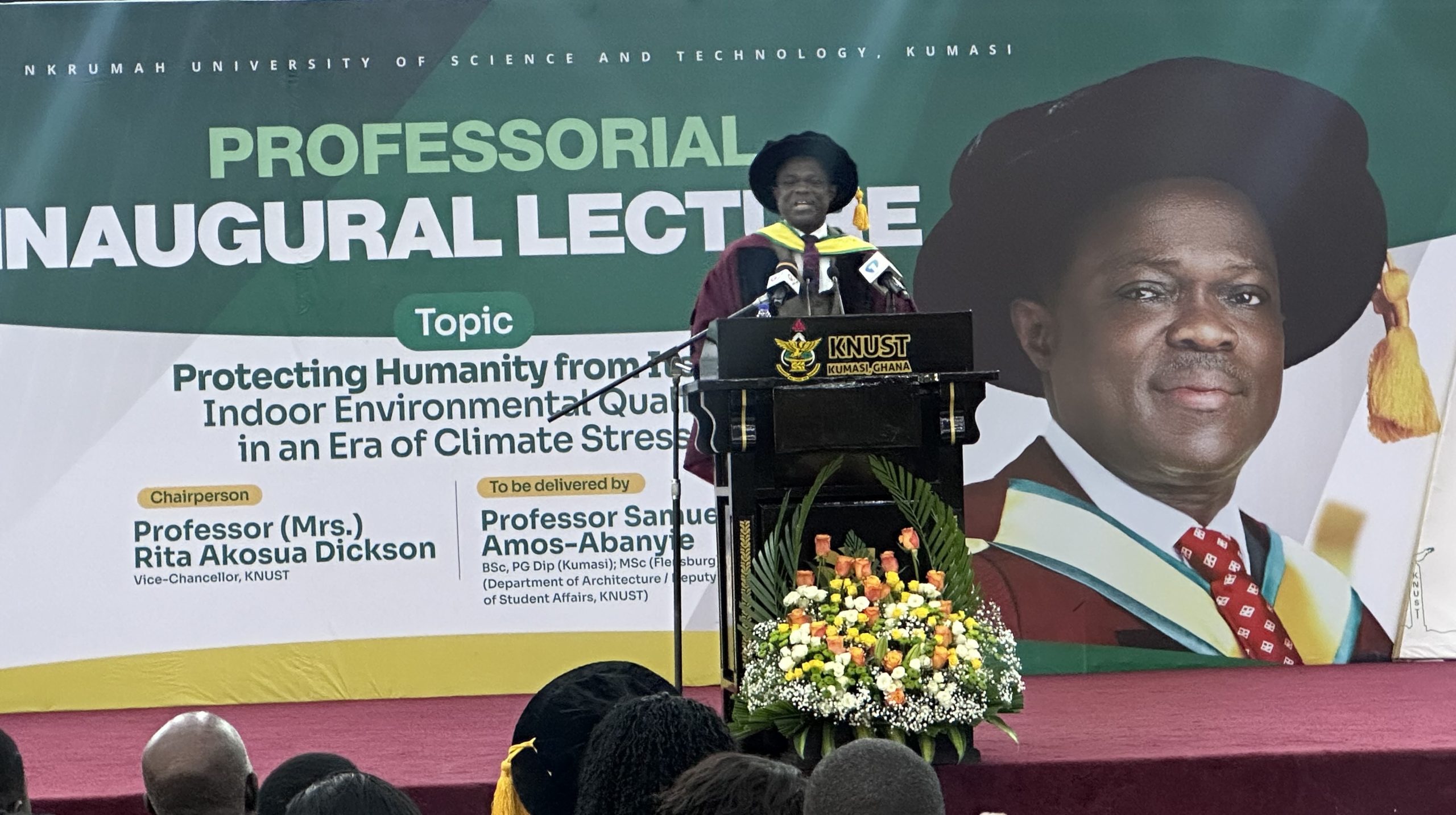
Delivering a compelling inaugural lecture at the Kwame Nkrumah University of Science and Technology’s (KNUST) Great Hall under a policy brief titled titled “Protecting Humanity from Itself: Indoor Environmental Quality in an Era of Climate Stress,” Professor Samuel Amos-Abanyie of the KNUST Architecture Department,
drew particular attention to FM stations as critical but often overlooked environments where poor acoustic conditions can negatively impact human health and performance.
He highlighted how targeted design interventions if given attention to can significantly improve acoustic conditions in high-noise environments such as FM studios to protect the health and safety of Media practitioners in Ghana particularly those in FM stations.
“Another critical, yet frequently neglected, component of Indoor Environmental Quality is acoustic comfort,” stressing that many urban environments- including media spaces have evolved into high-noise zones due to mixed land use and increasing commercial activity.
He emphasized that noise pollution often accepted as a normal part of urban life, can be effectively controlled through intentional design urging FM stations to engage professional architects in designing their studios and most importantly for periodic assessments.
He revealed findings from his research into sound conditions in broadcasting environments and urging some media houses to implement his recommendations saw to successful reduction of high-risk sounds in those FM studios from approximately 74.8 decibels to as low as 25 decibels through the application of integrated acoustic control strategies. This, he noted, demonstrates that deliberate architectural and engineering solutions can drastically improve sound quality and human comfort in professional spaces.
He stressed that such improvements are not merely technical achievements but essential interventions for safeguarding human wellbeing, especially in work environments where prolonged exposure to noise can affect concentration, communication, and overall health.
The professor explained that the issue of noise pollution extends beyond FM stations to urban Ghana as a whole, where increasing commercial activity, traffic, and the widespread use of generators contribute to elevated ambient noise levels.
“City dwellers are routinely exposed to ambient noise levels that exceed permissible limits,” he added, warning that such conditions have implications not only for comfort but also for long-term health and productivity.
Beyond acoustics, the policy brief broadly examined the growing threat of poor indoor environmental quality, linking it to respiratory illnesses, cardiovascular diseases, and cognitive decline. He argued that buildings must no longer be seen as passive structures but as active environments that directly influence human health and wellbeing.
The study further explored how climate change is intensifying indoor discomfort, revealing that rising temperatures and humidity levels in Ghana are increasing dependence on artificial cooling systems. However, the integration of passive design strategies, such as natural ventilation and material optimization, could reduce the need for air conditioning to less than 7 percent of the year, significantly cutting energy consumption and carbon emissions.
“The biggest threat to human survival in addition to the growing effects of climate change. The integration of passive and low energy cooling techniques can dramatically reduce the need for space cooling to an average of below 7 per cent of the time of the year.”
In his concluding remarks, he cautioned against the normalization of poor indoor conditions, stating: “Occupants accept inadequate daylight as ‘normal’. Communities internalise chronic noise as ‘urban life’. Buildings that suffocate, overheat, or contaminate are celebrated as ‘modern’.”
He maintained that with the right design approaches and policy interventions, improved indoor environmental conditions are achievable and essential to safeguarding public health.
Research Background
Professor Amos-Abanyie’s work spans architectural science with a focus on climate-responsive design, building performance modelling, indoor environmental quality, and sustainable building systems.
The lecture, delivered as part of his Professorial Inaugural Address was chaired by the Vice-Chancellor of KNUST, Professor Rita Akosua Dickson and attended by a cross-section of academics, architectural professionals, and senior media practitioners.
Source: Purefmonlinegh.com || 2026


