
Prez. Mahama praises Awuah Darko’s rice project as model for Ghana’s food self-sufficiency
By: Evans Osei-Bonsu
President John Dramani Mahama has lauded agribusiness investor, Kwame Awuah Darko for what he describes as a transformative contribution to Ghana’s quest for rice self-sufficiency, citing the latter’s 7,000-hectare mechanised rice project in the Afram Plains as a model for national development.
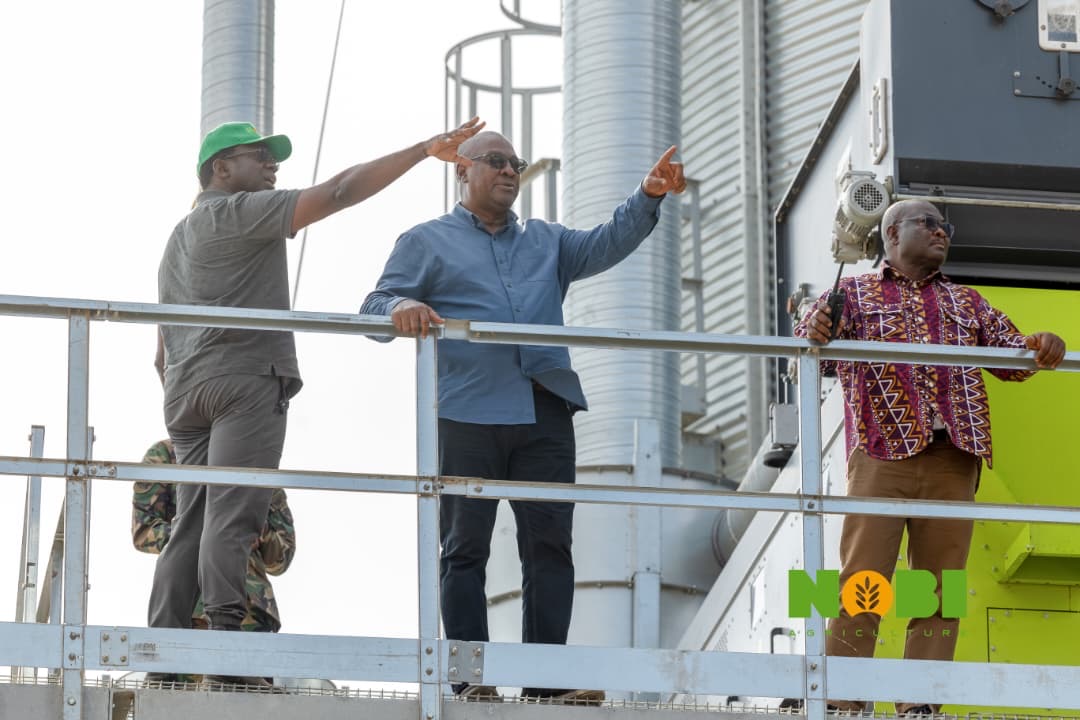
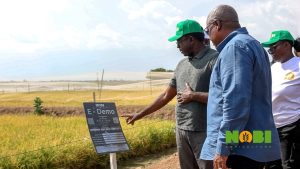
Speaking at an economic forum attended by leading business figures, Prez. Mahama recounted a recent visit to Hon. Awuah Darko’s expansive rice fields, where modern, scientific farming methods are being deployed to ensure year-round production. The President said the project offers a glimpse into how Ghana can reduce its heavy reliance on imported rice and strengthen domestic food systems.
“What Kwame Awuah Darko has done in the Afram Plains is beautiful- 7,000 hectares of land under rice cultivation, using scientific methods to ensure continuous yields throughout the year.”
“If we had just 20 of such farms across the country, Ghana would be self-sufficient in rice production. Mahama said.
Ghana has long grappled with a widening gap between domestic rice production and consumption. Despite various government interventions over the years, including initiatives like Planting for Food and Jobs, the country continues to import significant quantities of rice annually to meet local demand. This has placed pressure on foreign exchange reserves and exposed the country to global price shocks.
President Mahama stressed that while public policy plays a critical role, the private sector must take the lead in scaling up agricultural production.
“In our drive for food all year round and towards food sufficiency, the private sector should get involved like Awuah Darko has led. Government cannot do it alone,” he emphasized.

Awuah Darko, a former Managing Director of the Bulk Oil Storage and Transportation Company Limited (BOST), has in recent years shifted focus into large-scale agriculture, investing in mechanised farming techniques, irrigation systems, and improved seed varieties. His Afram Plains project is increasingly being cited as a benchmark for commercial agriculture in Ghana.
The Afram Plains, located in the Eastern Region, has long been identified as one of Ghana’s most fertile agricultural zones, with vast tracts of arable land suitable for rice cultivation. However, underinvestment, poor infrastructure, and limited access to modern farming inputs have historically constrained its full potential.
Some Agricultural economists have already argued that scaling up projects like Awuah Darko’s could significantly reduce Ghana’s import bill while creating jobs and enhancing rural livelihoods.
“Ghana seeks sustainable solutions to food security challenges amid rising global uncertainties.
As the country continues to explore pathways to agricultural transformation, Awuah Darko’s venture in the Afram Plains may well stand as a compelling case study of what is possible when investment meets innovation, and scale converge in Ghana’s agricultural sector.” Dr. Charles Obomeng, an Agricultural Economist noted in a previous interview on Kumasi-based Pure FM.
Source: Purefmonlinegh.com || 2026