A leading Ghanaian academic has delivered a scathing critique of the country’s economic model, warning that decades of policy failures have transformed Ghana into a nation that consumes more than it produces, leaving thousands unemployed and the country’s once-thriving textile industry on life support.
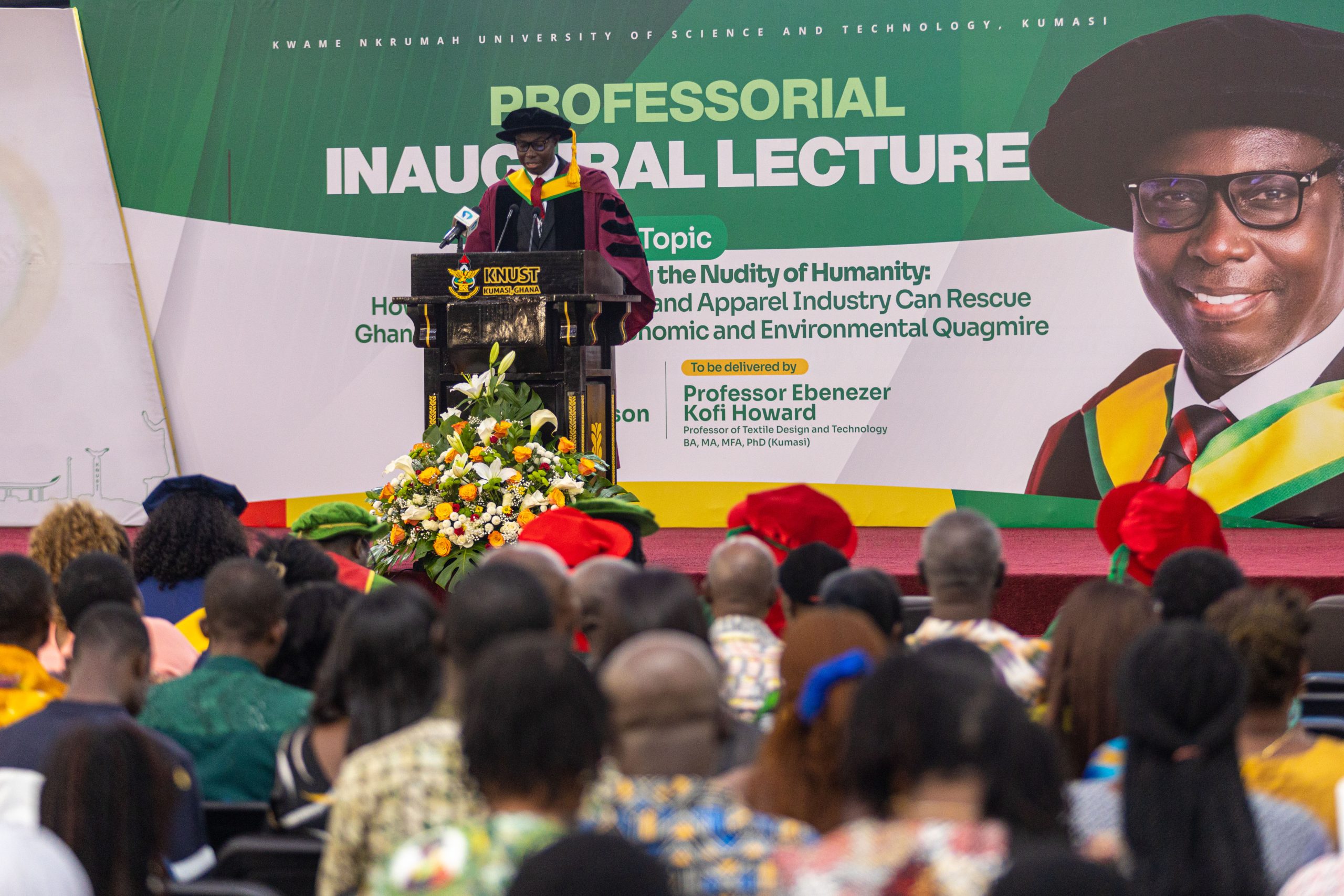
Delivering his Professorial Inaugural Lecture at the Kwame Nkrumah University of Science and Technology’s (KNUST) Great Hall on Thursday, Professor Ebenezer Kofi Howard argued that Ghana’s political leaders have failed to harness the enormous potential of the textiles and apparel sector, despite its proven ability to drive industrialisation, create jobs and stimulate economic growth.
The textile scholar warned that Ghana is gradually becoming a “marketing economy” where citizens merely buy and sell imported products while local industries struggle to survive.
“The country’s economy is gradually becoming a marketing economy where everyone is buying and selling,” Professor Howard lamented, pointing to the nation’s growing dependence on imported textiles, second-hand clothing and other consumer goods.
In what appeared to be a direct challenge to Ghana’s economic management over the years, the Professor questioned whether the country can genuinely claim economic independence while relying heavily on imports for products that can be produced locally.
“Are we really independent?” he asked. “How do we justify our independence and self-reliance philosophy without prioritising production?”
His remarks come at a time when both the governing administration and opposition parties continue to debate solutions to unemployment, industrialisation and economic transformation.
Professor Howard argued that the answer may have been overlooked all along.
According to him, the global textiles and apparel industry is worth more than US$5 trillion and employs over 300 million people worldwide, making it one of the largest employment-generating sectors on earth. Yet Ghana, once regarded as one of West Africa’s textile powerhouses, now imports more than 70 per cent of its textiles and garments while exporting less than 10 per cent.
“The contrast is striking.” He remarked.
“Following independence, Ghana established more than 40 large-scale textile companies, including Akosombo Textiles Limited, Ghana Textile Printing Company and Juapong Textiles. The sector employed over 25,000 workers and accounted for 27 per cent of manufacturing sector employment.”
“Today, fewer than 2,000 workers remain employed across the country’s surviving large-scale textile firms.” He stated.
Professor Howard attributed the collapse to trade liberalisation policies, unchecked imports, smuggling, weak protection for local industries and the gradual destruction of Ghana’s cotton production base.
He noted that despite numerous interventions by successive governments, including import restrictions, anti-smuggling measures, the Presidential Special Initiative, One-District-One-Factory and the National Friday Wear campaign, the industry continues to deteriorate.
Perhaps his most politically charged observation was his warning that countries which fail to produce their own necessities risk surrendering their economic sovereignty.
Drawing inspiration from African leaders such as Kwame Nkrumah, Thomas Sankara and Nelson Mandela, Professor Howard argued that excessive dependence on imports and foreign production exposes countries to economic vulnerability and external control.
“If Ghana and other African countries continue these habits of buying and selling without prioritising production, we will forfeit our independence credibility and become slaves to our trade masters,” he cautioned.
“The solution is straightforward: revive local production, strengthen the textiles and apparel value chain, create jobs through manufacturing and stop treating industrialisation as a political slogan.” He concluded.
The Professorial inaugural lecture was graced by the Vice-Chancellor of the KNUST, Professor Rita Akosua Dickson, academic and administrative staff and students from the College of Arts and Built Environment.
Source: Purefmonlinegh.com || Evans Osei-Bonsu || 2026